
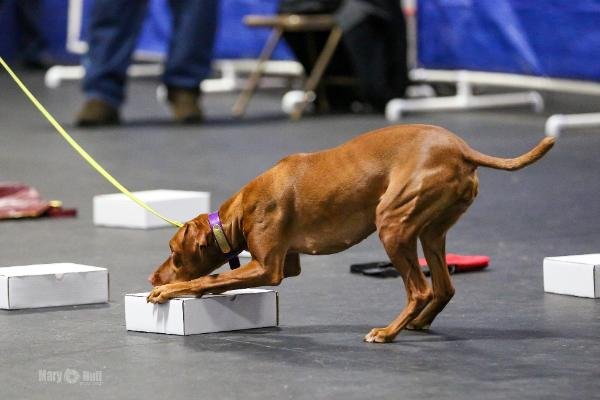
Dogs experience the world through their nose. When a dog sniffs a trail, toy, person, or object, it does not simply smell one thing. It sorts many scent details at the same time and decides which odor matters.
From my experience studying canine behavior and training methods, I have found that scent work reveals how powerful a dog’s natural skills can be. A family dog searching for a hidden toy uses the same basic ability that professional detection dogs use in the United States.

What is dog scent discrimination?
Dog scent discrimination means a dog can tell the difference between target odors and other smells around it. The dog learns that one scent has value while other scents are distractions.
This skill is important because real environments contain many competing smells. A search dog may need to find one person’s scent in a busy park or detect one odor among thousands of background smells.
- ✦ Target odor recognition
The dog learns to notice and respond to a specific smell chosen during training.
- ✦ Distraction control
The dog ignores unrelated smells and stays focused on the correct odor.
How dogs separate different smells
A dog does not smell like a human. Human brains focus mostly on vision, while dogs collect detailed information from odors.
When dogs sniff, they compare scent patterns and use memory to match familiar smells.
How a dog’s nose supports scent discrimination
A dog’s nose is designed for detailed odor analysis. Air moves through special nasal structures that help capture scent molecules.
The brain then processes these signals and creates a scent picture. This allows dogs to recognize individuals, objects, and locations.

- ✦ Scent memory
Dogs can remember many odors and connect them with past experiences.
- ✦ Continuous sampling
Dogs often sniff repeatedly because each breath provides more scent information.
Why sniffing is natural behavior
Sniffing helps dogs gather information about their environment. It is not simply a distraction during walks.
Allowing safe sniffing activities can provide mental exercise and reduce boredom.
How scent discrimination training works
Dog scent discrimination training usually begins with simple games. Trainers introduce a clear target odor and reward the dog for choosing it.
Over time, the trainer adds more challenges. The dog learns to ignore extra smells and make accurate choices.

- ✦ Step one: Introduce the scent
The dog learns that a specific odor leads to a reward.
- ✦ Step two: Add distractions
Other smells are added so the dog practices making the correct choice.
- ✦ Step three: Increase difficulty
Distance, locations, and hidden targets make the task more realistic.
Common scent training activities
Many owners use scent games at home. Examples include finding hidden treats, locating toys, or identifying scent containers.
These activities can improve confidence because dogs solve problems using their strongest natural sense.
Uses of dog scent discrimination in real life
Dog scent discrimination has many practical uses in the United States. Professional teams train dogs for detection, search work, and assistance tasks.
The same ability can also create fun activities for household pets. A family dog does not need professional training to enjoy scent games.

- ✦ Search and rescue dogs
These dogs use scent skills to locate missing people in different environments.
- ✦ Medical alert dogs
Some trained dogs learn to respond to scent changes linked with health events.
- ✦ Sport and enrichment
Scent sports give dogs a safe way to use their natural abilities.
Why scent work benefits pet dogs
Scent games can provide mental stimulation for dogs of many ages. Older dogs may enjoy slower searches, while younger dogs can practice focus.
The goal is not perfection. The goal is helping dogs use their natural behavior in a positive way.
Factors that affect a dog’s scent discrimination ability
Not every dog performs scent tasks the same way. Breed traits, age, health, training methods, and motivation can influence results.
A dog with a strong nose still needs clear training. Good scent discrimination comes from both natural ability and practice.
- ✦ Breed differences
Some breeds were developed for hunting or tracking and may show strong scent interest.
- ✦ Training quality
Reward-based training often helps dogs stay confident and willing to search.
- ✦ Environment
Wind, weather, surfaces, and background odors can change scent conditions.
