
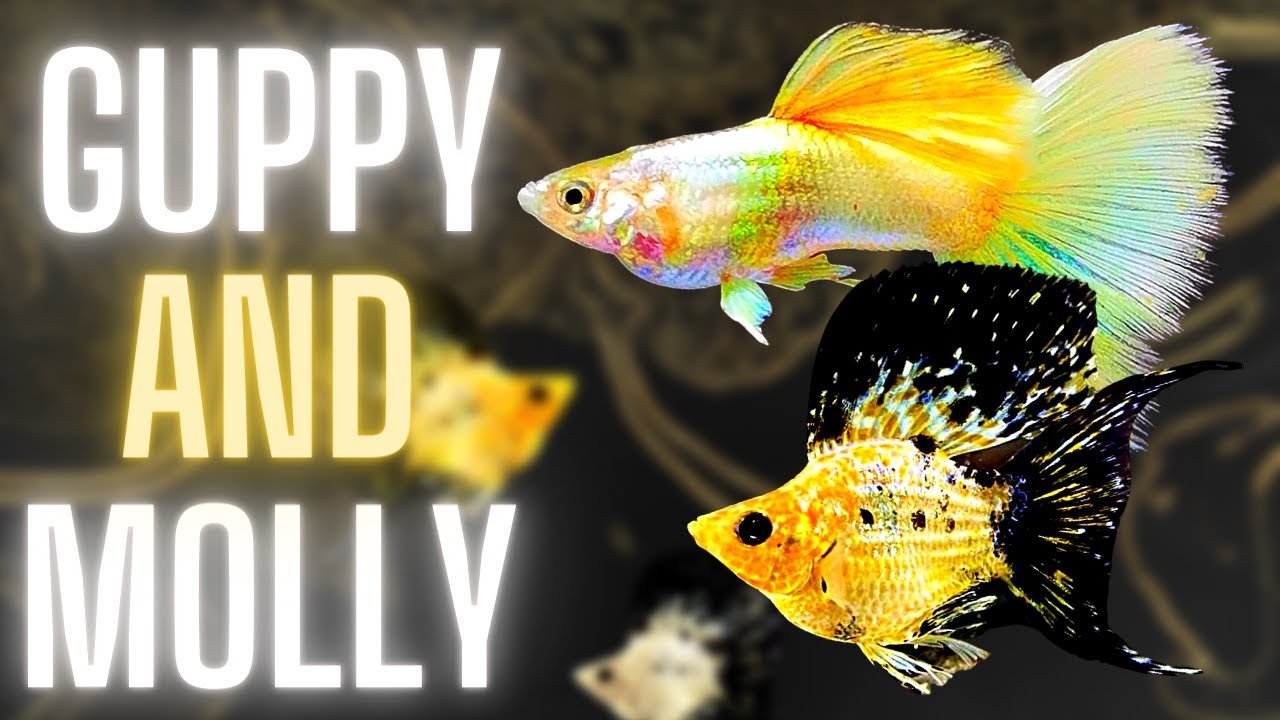
Mollies are larger and hardier; guppies are smaller, colorful, and breed faster.
I’ve kept both mollies and guppies for years and studied their needs closely. This guide on molly vs guppy fish explains their key differences, care needs, and how to choose the best fit for your tank. Read on for clear, practical advice based on hands-on experience and aquarium best practices.
Molly vs Guppy: Quick Comparison Table
| Feature | Guppy | Molly |
|---|---|---|
| Scientific name | Poecilia reticulata | Poecilia sphenops (common), P. latipinna (sailfin) |
| Adult size | 1.5–2.5 in (4–6 cm) | 3–4.5 in (7.5–11 cm); sailfin varieties up to 6 in (15 cm) |
| Minimum tank size | 10 gal (38 L) | 20 gal (75 L)+, more for sailfin |
| Temperature | 72–82°F (22–28°C) | 72–78°F (22–28°C) |
| pH range | 6.8–8.0 | 7.5–8.5 |
| Water hardness (dGH) | 8–12, tolerant of higher | 12–30 |
| Brackish tolerance | Tolerant | Very tolerant; some strains kept in brackish or marine setups |
| Temperament | Peaceful, active | Mostly peaceful; males can be semi-aggressive/nippy |
| Diet | Omnivore | Omnivore, benefits from more plant matter/algae |
| Fry per brood | ~20–50 | ~10–60, sailfin broods can run larger |
| Lifespan | 2–3 years | 3–5 years |
| Beginner-friendly | Yes | Yes, but needs more space and harder water |
Guppies and mollies are both easy-care livebearers, but guppies suit smaller tanks and softer water, while mollies need more space and harder, more alkaline conditions.

Overview: molly vs guppy fish
Mollies and guppies are livebearers. They give birth to free-swimming fry rather than laying eggs. Both come in many colors and varieties. They are popular for beginners and experienced keepers alike.
This molly vs guppy fish overview shows origins, common types, and what to expect. Mollies often hail from brackish and freshwater habitats. Guppies come from tropical freshwater streams. Knowing their backgrounds helps you match water and diet to each fish.
Guppies and mollies are not the same fish, but they’re closely related.
Both belong to the livebearer family Poeciliidae, and both sit in the same genus, Poecilia. The guppy is Poecilia reticulata. “Molly” is a common name that covers several species, most often the common molly (Poecilia sphenops) and the sailfin molly (Poecilia latipinna).
Guppies are also historically known as “millionfish” for how fast they breed, and mollies are sometimes sold simply as “molly fish.”

Source: reddit.com
Types of Molly Fish
| Variety | What Sets It Apart |
|---|---|
| Common (short-fin) molly | Standard fin shape, wide range of solid colors |
| Black molly | Solid black body |
| Sailfin molly | Large, sail-like dorsal fin; grows larger than other varieties |
| Balloon molly | Selectively bred curved spine giving a rounded body shape |
| Dalmatian molly | Black-and-white speckled pattern |
| Marble molly | Mottled, marbled color pattern |
| Gold dust / golden molly | Yellow-gold body color |
| Panda molly | Black-and-white or black-and-gold patched pattern |
| Lyretail molly | Lyre-shaped (forked, elongated) tail fin |
| Koi molly | Orange, black, and white patches resembling koi carp |
| Silver molly | Silvery-white body color |
Note on balloon mollies: the rounded body shape comes from a spinal curvature bred into the strain, which some keepers avoid on welfare grounds.
Types of Guppy Fish
| Variety | What Sets It Apart |
|---|---|
| Fancy guppy | General term for guppies bred for color/finnage, standard fin shape |
| Neon guppy | Iridescent blue-green coloring |
| Moscow guppy (incl. Blue Moscow) | Dense, solid metallic body color |
| Cobra guppy | Snakeskin-like patterned body |
| Tuxedo guppy | Two-tone body — dark rear half, lighter front half |
| Endler’s guppy | Technically a separate species (Poecilia wingei), often grouped with guppies; smaller and more intensely colored, and can crossbreed with common guppies |
Physical differences and appearance
Molly vs guppy fish differ in shape and look. Mollies are typically thicker bodied. Guppies are smaller with fan-like tails in many showy forms.
Common visual traits:
- Molly: rounded body, larger size, sail-like dorsal fins in some strains.
- Guppy: slender body, wide variety of tail shapes and colors, often more flamboyant.
- Color range: Both species show black, silver, orange, and patterned forms.
Seeing them side by side makes the difference obvious. Mollies often have a subtler palette but a sturdier look. Guppies can be dazzling in community displays.

Source: youtube.com
Size, lifespan, and growth
Size and life length matter for tank planning. Mollies grow to about 3–4 inches. Guppies stay smaller, around 1.5–2.5 inches. That size gap affects how many fish you can keep.
Lifespan expectations:
- Molly: typically 3–5 years with good care.
- Guppy: typically 1–3 years, though some reach 4 years.
Growth and lifespan depend on water quality, diet, and genetics. I learned this after losing young fish to crowded tanks; proper space improved survival a lot.

Source: reddit.com
Temperament and tank compatibility
Temperament influences tank mates and community layout. Both species are peaceful but have differences that matter.
Temperament notes:
- Molly: Generally calm but can nibble plant leaves. They do well with medium-sized peaceful fish.
- Guppy: Very peaceful and active. They can be shy with larger, aggressive fish.
- Social needs: Both prefer groups. Keep at least 4–6 of one species to reduce stress.
If you mix them, watch behavior for a week. In my tanks, mollies tolerated guppies but sometimes outcompeted them for food because of size. Balance feeding to keep both healthy.

Source: youtube.com
Water parameters and care requirements
Water matters more than color. Mollies tolerate slightly brackish water. Guppies prefer stable tropical freshwater. Matching parameters keeps them healthy.
Recommended ranges:
- Temperature: both prefer 74–80°F (23–27°C).
- pH: mollies 7.5–8.5, guppies 7.0–8.0. Mollies lean toward alkaline.
- Hardness: both like moderate to hard water. Mollies handle harder water better.
- Salinity: a pinch of aquarium salt helps mollies; guppies tolerate small amounts but do best without added salt.
Maintain steady water changes. I do weekly 20% water changes for mixed tanks. That cut down stress and disease in my experience.
For a closer look, here’s how hardness compares directly:
| Parameter | Guppy | Molly |
|---|---|---|
| General hardness (dGH) | 8–12, tolerant of higher | 12–30 |
Mollies, being the larger-bodied of the two, also tend to produce more waste per fish than guppies — worth factoring into filtration if your stock leans molly-heavy.

Source: gtoperu.com
Diet and feeding
Diet shapes health and color. Both fish are omnivores that enjoy varied food. Good feeding boosts color and lifespan.
Diet tips:
- Staple: high-quality flake or micro-pellet food.
- Supplement: live or frozen foods like brine shrimp, daphnia, and bloodworms.
- Vegetables: blanched zucchini or spinach for mollies, which enjoy some greens.
- Frequency: feed small amounts twice daily. Remove uneaten food after a few minutes.
Overfeeding causes poor water quality. I learned the hard way that small, frequent feeds work better than one large feeding.

Source: youtube.com
Breeding and population control
Both species breed easily. That is a plus for breeders and a challenge for small tanks.
Breeding facts:
- Gestation: about 21–30 days for both species.
- Fry: guppies have high fry counts and breed faster. Mollies produce fewer fry but still often.
- Control: use a breeder box, separate sexes, or introduce predators like larger fish if you don’t want many fry.
I separate mothers before they give birth. It improved fry survival and kept the main tank from getting crowded.
Can Guppies and Mollies Crossbreed?
It’s a common question whether guppies and mollies can crossbreed with each other. The technical answer is yes — they belong to the same genus, Poecilia, which makes hybridization biologically possible, unlike a cross with a platy (different genus entirely — see below).
In practice, guppy-molly hybrids (informally called “gollies” or “muppies” depending on which parent is which) are rare, and the offspring are typically weak, prone to health problems, and sterile.
Most fry you’ll see in a mixed tank are simply guppy fry and molly fry born separately, not hybrids — and you can usually tell them apart early on, since molly fry are generally born larger and rounder-bodied than the slimmer, smaller guppy fry.

Source: youtube.com
Choosing between molly vs guppy fish
Deciding comes down to goals. Think about tank size, maintenance, and desired look.
Choose mollies if:
- You have a larger tank or slightly brackish setup.
- You want hardier fish that handle tougher water.
- You like a subtle, sturdy look.
Choose guppies if:
- You want bright colors and ornate tails.
- You have a smaller tank or want many active fish.
- You enjoy breeding and seeing many fry.
I kept guppies when I wanted color and activity. I chose mollies when I needed a robust community member that tolerates more variable water.
How Much Do Mollies and Guppies Cost?
Prices vary widely by variety, region, and retailer, so treat any number as a starting point rather than a quote. As a general pattern, common short-fin guppies and common mollies are usually the least expensive options at a local fish store, while fancier or rarer strains — sailfin mollies, balloon mollies, marble or koi mollies, Moscow guppies — cost more due to selective breeding.
For accurate current pricing, check listings at your local fish store or a marketplace serving your specific country, since regional cost differences come down to local supply rather than the fish itself.
Common health issues and prevention
Both species get similar diseases. Good care prevents most problems.
Common issues:
- Ich: white spots that arise from stress or sudden temp changes.
- Fin rot: from poor water and bacterial infections.
- Swim bladder problems: often linked to diet or overfeeding.
Prevention tips:
- Keep water clean with regular changes.
- Feed varied diet and avoid overfeeding.
- Quarantine new fish to stop disease spread.
When I spot early signs, I isolate the fish and adjust water. Quick action usually saves them.
Quick PAA-style questions
How many guppies per gallon is safe?
A common rule is one inch of fish per gallon. For guppies, aim for 1 guppy per 2 gallons to allow activity and stable water.
Can mollies live with guppies?
Yes, mollies can live with guppies if tank size, diet, and water are balanced. Monitor for competition at feeding time.
Do mollies need salt?
Mollies handle and sometimes prefer slightly brackish water, so a small amount of aquarium salt can help. Use salt carefully and research dose for livebearers.
Frequently Asked Questions of molly vs guppy fish
What are the main habitat differences between mollies and guppies?
Mollies often come from brackish and coastal waters, so they tolerate slight salinity. Guppies come from freshwater streams and prefer stable freshwater conditions.
Which species is easier for beginners, mollies or guppies?
Both are beginner-friendly, but guppies are often easier because of smaller size and simpler water needs. Mollies tolerate a wider range of conditions but may need slightly higher pH.
How fast do guppies and mollies reproduce?
Guppies reproduce quickly and frequently, producing many fry. Mollies also breed often but usually yield fewer fry per birth.
Can I mix male and female ratios to control breeding?
Yes. Keeping more males than females reduces fry but can stress females. A 2:1 female-to-male ratio generally balances breeding and stress.
What tank size is best for a mixed molly and guppy tank?
A 20-gallon tank or larger is best for a mixed group to reduce stress and give space for hiding and feeding.
Can guppies and mollies breed with each other?
Yes, technically — they share the same genus, Poecilia — but it’s uncommon, and the resulting hybrid fry are usually weak and sterile. Most fry in a mixed tank are simply guppies or mollies breeding within their own species.
What’s the scientific name for a molly / guppy?
The guppy’s scientific name is Poecilia reticulata. “Molly” covers a few species — most commonly Poecilia sphenops (common molly) and Poecilia latipinna (sailfin molly).
Are mollies or guppies aggressive?
Neither is considered an aggressive species. Male guppies will chase and nip at each other and at females when breeding, and male mollies can act semi-aggressive toward smaller or slower tankmates, but both are classified as peaceful community fish overall.
How does a platy compare to mollies and guppies?
Platies belong to a different genus, Xiphophorus, unlike guppies and mollies, which share the genus Poecilia — so unlike guppies and mollies, platies can’t interbreed with either. In size and care, platies sit close to guppies, and are considered at least as hardy. For a full breakdown.
Conclusion
Mollies and guppies each bring strengths. Mollies offer hardiness and a robust presence. Guppies offer color, activity, and prolific breeding. Choose based on tank size, water conditions, and whether you want showy colors or a hardy community fish. Try one species first or create a balanced mixed tank with careful observation.
Take action: set up stable water, plan space for fry, and pick the species that matches your routine. If you liked this guide, leave a comment and share your own molly vs guppy fish stories.
