
Many American dog owners face challenges with barking, fear, stress, or reactions to sounds, people, animals, and daily events. The Dog desensitization process helps dogs learn that a trigger does not always mean danger.
In professional training, I have seen that rushing exposure often creates more stress. A calm plan that respects the dog’s comfort level usually creates stronger and more lasting results.
What is the Dog desensitization process?
The Dog desensitization process is a training method that changes how a dog responds to a stressful trigger. The dog sees or experiences the trigger at a very low level that does not create panic.
Over time, the dog learns that the trigger is safe. This process is often combined with counter conditioning, where the dog connects the trigger with something positive such as treats, play, or praise.
- ✦ Controlled exposure
The dog experiences the trigger in small steps instead of facing the full challenge at once.
- ✦ Positive association
Rewards help the dog create a calmer emotional response.
Desensitization vs normal exposure
Normal exposure may force a dog to face a fear before it is ready. Desensitization works differently by keeping the experience manageable.
The goal is not to make the dog ignore everything. The goal is to help the dog feel safe and confident.
Why dogs need desensitization training
Dogs may develop fear or reactivity because of genetics, limited early experiences, past events, or sudden changes. Common triggers include fireworks, strangers, other dogs, car rides, grooming tools, and household noises.
The Dog desensitization process gives owners a structured way to help dogs handle these situations without increasing fear.

- ✦ Common behavior problems
Barking, hiding, lunging, shaking, avoiding, and defensive reactions can be linked to fear or stress.
- ✦ Daily life improvement
A calmer dog can enjoy walks, visitors, grooming, and new experiences more comfortably.
Steps in the Dog desensitization process
A successful Dog desensitization process follows a slow progression. Each dog moves at a different speed, so the plan should match the dog’s behavior and comfort.
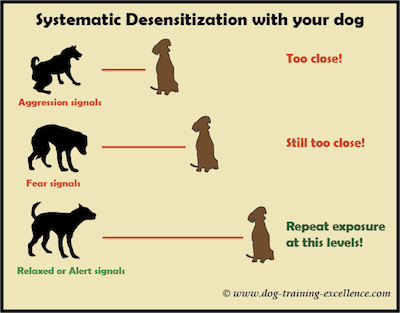
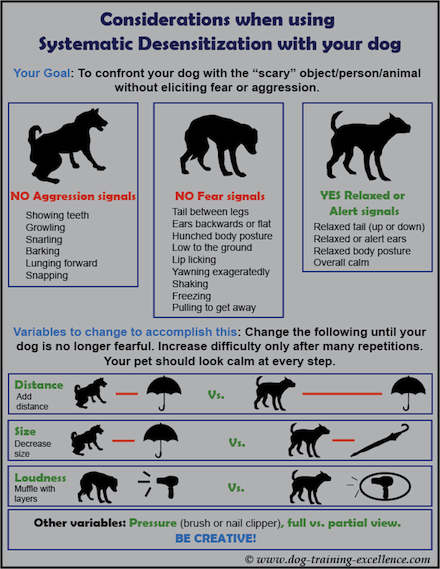
Owners should watch body language closely. Signs like stiff posture, whining, heavy panting, or refusal of treats mean the dog may be too close to the trigger.

- ✦ Step 1: Identify the trigger
Find the exact situation that creates stress, such as a loud sound or another dog.
- ✦ Step 2: Start at a safe distance
Begin where the dog notices the trigger but can still stay calm.
- ✦ Step 3: Reward calm behavior
Give rewards when the dog remains relaxed during exposure.
- ✦ Step 4: Increase difficulty slowly
Reduce distance or increase intensity only when the dog is comfortable.
Understanding a dog’s threshold during training
A dog’s threshold is the point where emotions become too strong to manage. Below the threshold, a dog can learn. Above it, the dog may react instead of learning.
Managing distance, time, and intensity is one of the most important parts of the Dog desensitization process.

- ✦ Below threshold
The dog can look at the trigger, respond to cues, and accept rewards.
- ✦ Over threshold
The dog may bark, freeze, run away, or ignore training.
Reading body language
Small signals often appear before a big reaction. Learning these signals helps owners adjust training before stress grows.
Dog desensitization process for common triggers
Different triggers require different training plans. A dog afraid of thunder needs a different approach than a dog reacting to other dogs on walks.
The same core rule applies: begin with a small challenge and build confidence slowly.

- ✦ Noise fears
Use low-volume sounds and slowly increase volume while rewarding calm behavior.
- ✦ Dog reactivity
Practice at a distance where the dog can notice another dog without reacting.
- ✦ Handling fears
Introduce grooming tools, touch, and vet handling in small positive steps.
